Parking at Myrtle Beach and Murrells Inlet Just Got More Complicated.
Here's What Visitors Need to Know.
- Private parking enforcement is expanding along the Grand Strand; expect previously free lots to be managed by companies like Taggr.
- These are not police tickets, private notices are civil matters; companies can tow vehicles but cannot affect your driving record or bring criminal charges.
- Scammers mimic legitimate notices with QR codes and plate photos; do not scan QR codes before verifying the notice's legitimacy.
- Before paying, go inside the business and ask staff to confirm and get validation documentation, like a stamped ticket or receipt.
- If you cannot verify a notice, do not pay; contact the property owner independently and report suspicious notices to the Myrtle Beach Police Department.
You pull into the parking lot at the Murrells Inlet Marshwalk, same lot
you've used a dozen times before. You grab your sunglasses, lock the car,
and head toward your favorite restaurant. When you come back, there's a
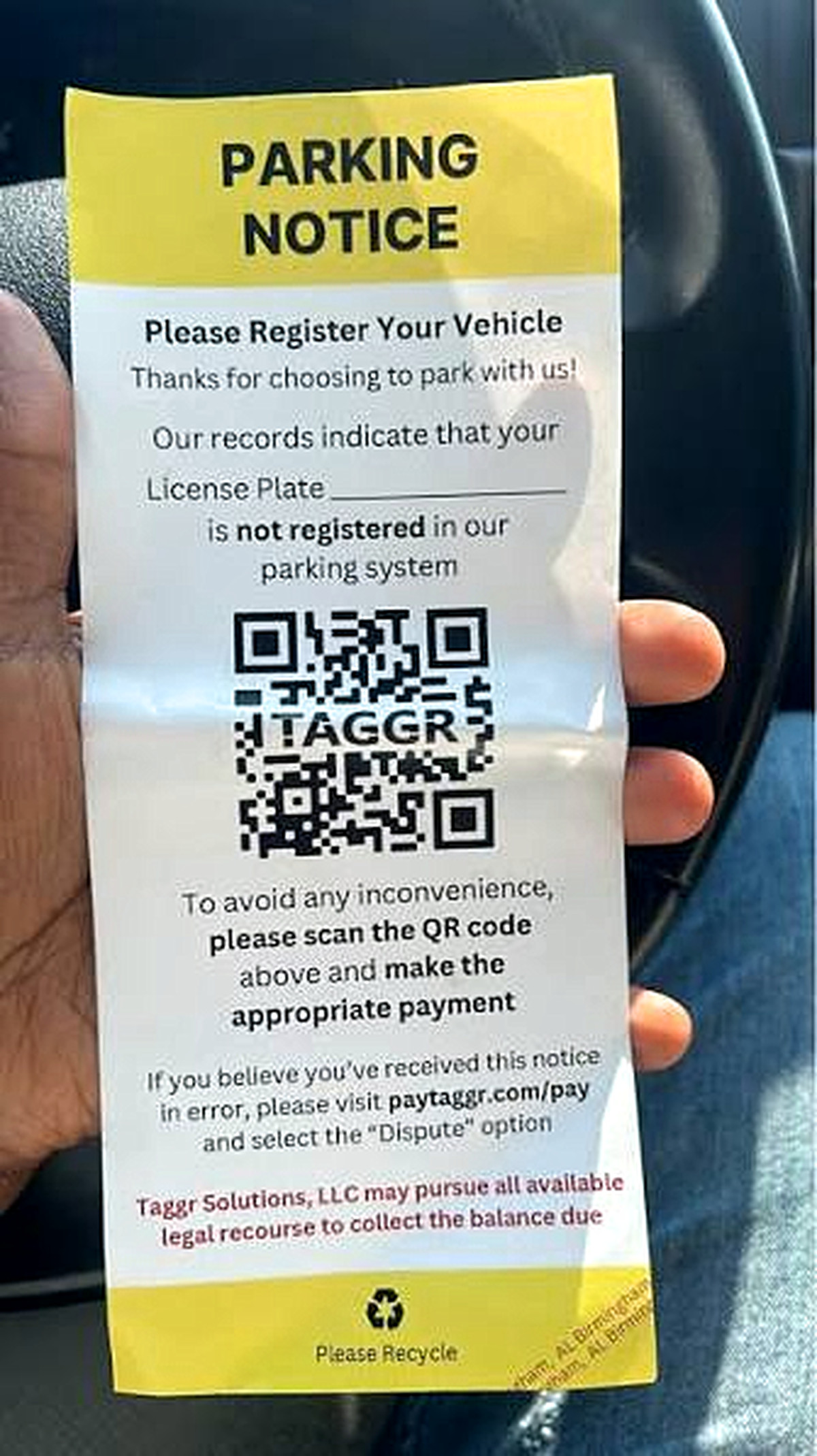
notice on your windshield that looks a lot like a parking ticket.
You didn't do anything wrong. You're pretty sure. But the notice has urgent
language, a QR code, maybe even a photo of your license plate. And now
you're standing in a parking lot trying to figure out if you owe somebody
money.
This is happening more often along the Grand Strand and Murrell's Inlet,
and it's worth understanding before your next trip there.
What's Actually Changed
Restaurants and retailers in the Myrtle Beach area and Murrells Inlet have
increasingly turned to third-party companies to manage their parking lots.
The reason is straightforward: they want their spaces used by actual
customers, not beachgoers or day-trippers who park for free and walk
somewhere else.
The biggest name in the area is Taggr, a parking enforcement company
founded right in Myrtle Beach. Taggr operates under contract with private
property owners. They are a legitimate, licensed business. When they leave
a notice on your car, it is because the property owner has hired them to do
exactly that.
But here's what catches visitors off guard: lots that had no parking
requirements a year or two ago now do. Places you've parked before without
a second thought are now under private enforcement. The Marshwalk area in
Murrells Inlet is one example people are talking about. Myrtle Beach has
similar situations. The trend is expanding, and it's moving faster than
most visitors realize.
These are not police tickets. No law enforcement agency is involved.
Private enforcement companies like Taggr have real authority over the lots
they manage — including the ability to have your vehicle towed — but they
cannot put anything on your driving record or have you charged criminally.
Unpaid private parking notices are a civil matter, not a criminal one.
Why It Feels Like a Scam Even When It Isn't
Private parking enforcement creates a problem it didn't entirely ask for:
it looks almost identical to an actual scam.
The Myrtle Beach Police Department has issued warnings about fraudulent
parking notices circulating in the area. The setup is simple. Someone
prints a stack of notices that mimic legitimate private enforcement —
urgent language, a QR code, sometimes a photo of your actual license plate.
You scan the code and land on a payment page. In some cases that page
processes a real transaction to a fake recipient. In others, it just
collects your card information for later use.
The problem is that a legitimate Taggr notice and a fraudulent copycat
notice can look nearly the same to someone who has never seen either one
before. When you're standing in a parking lot in the August heat, trying to
figure out what just happened to your vacation afternoon, that distinction
is not obvious.
One woman commented online that she got a notice near the Marshwalk and was
genuinely confused. She'd been parking there for years. No fees, no
notices. This time was different, and she had no way of knowing if the
notice was from a legitimate company or not.
That's the real issue. Not that Taggr is a scam — it isn't — but that the
proliferation of private parking enforcement has created an environment
where scammers can operate almost invisibly alongside legitimate companies,
and visitors have no easy way to tell the difference on the spot.
The One Rule That Matters
Do not scan the QR code and pay before you've confirmed the notice is
legitimate.
Full stop.
Before you touch the QR code, before you call any number printed on the
notice, before you visit any website listed on it — walk into the nearest
business and ask a human being. If you parked in a restaurant lot to eat
there, the staff can tell you whether the lot uses a contracted enforcement
company and whether the notice you're holding is from them. Many businesses
validate parking for customers. If yours does, get documentation: a stamped
ticket, a receipt, a photo of the validated notice.
The extra two minutes are worth considerably more than whatever the notice
is asking you to pay.
What to Look For Before You Park
Most municipalities require signage when a private lot charges for parking.
The rules don't guarantee you'll see a billboard at every entrance. It
might be a single sign posted at one driveway, a notice on a building wall
that a parked car is currently blocking, or a sandwich board tucked under a
store awning. Signage requirements exist to inform you. They are not
required to be impossible to miss.
If you're unsure whether the lot you're pulling into has a fee, ask before
you walk away from the car. Check the business directly. Look for posted
signage at the entrance. Thirty seconds of uncertainty up front is a lot
easier than sorting out a disputed charge on your credit card statement
three weeks later at home.
If You Already Have a Notice on Your Windshield
Here's what to do:
Go inside first. Ask the adjacent business to confirm whether the notice is
from their contracted parking company.
If you're a customer and the notice is legitimate, ask about validation. If
they validate parking, get documentation — a receipt, a stamped ticket,
something in hand.
If you cannot verify the notice, do not pay through the QR code or any
number printed on it. Find a contact for the property owner independently
and reach out that way.
If something feels wrong, report it to local law enforcement. The Myrtle
Beach Police Department is aware of the fraudulent notice issue and wants
to hear about suspicious activity.
If the notice is legitimate and you choose not to pay, the enforcement
company's options are limited. They can tow your vehicle from their lot on
a future visit. A civil claim over a parking fee is theoretically possible
but unlikely. What they cannot do is affect your driving record or pursue
criminal charges.
The Bottom Line
Private parking enforcement is expanding in Myrtle Beach and Murrells
Inlet, and it's catching visitors off guard — especially in places where
parking was free and easy not that long ago. Most of the notices being
issued are legitimate. The companies doing the enforcing are real
businesses with real contracts. But the situation has created enough
confusion that scammers have found a way to work the same territory, and
that's the part that should make you careful.
Add this to your pre-trip checklist alongside sunscreen and a plan for
traffic on 17. Know where you're parked, know who owns the lot, and if a
notice shows up on your windshield, find a person to talk to before you do
anything else.